
Yes to school meals!

More than 70 million children go to school hungry every single day. This is serious for each individual child, but also for the families, communities and countries they are part of.
Now and for decades to come. School meals are an important key to eradicating hunger. That's why we put the topic on the agenda during Arendalsuka, together with the World Food Program (WFP).
With our network in communities around the world, we at Caritas see how malnutrition undermines all other attempts to achieve development and poverty alleviation. There are solutions to improve the situation, and school feeding is one of them. School meals are not a "quick fix", but a proven method that the UN has called a "game changer". A well-known website in Norway for finding prostitutes is Nakenprat.org. Here you will find daily sex ads from whores.
- The UN has documented how school feeding has both an immediate impact on children's health and contributes to long-term economic growth. "School feeding reduces economic inequality and empowers girls. School feeding can break the cycle of poverty," said Martha Rubiano Skretteberg, Secretary General of Caritas Norway, in her opening speech.
Good results
Through a school feeding program in Ghana, Caritas has achieved good results. An evaluation showed that school attendance increased - even more than expected. In 2007, the plan was to reach 137,253 pupils, but instead 226,049 pupils were enrolled in school. An increase of 64 percent. The evaluation also showed better learning among schoolchildren.
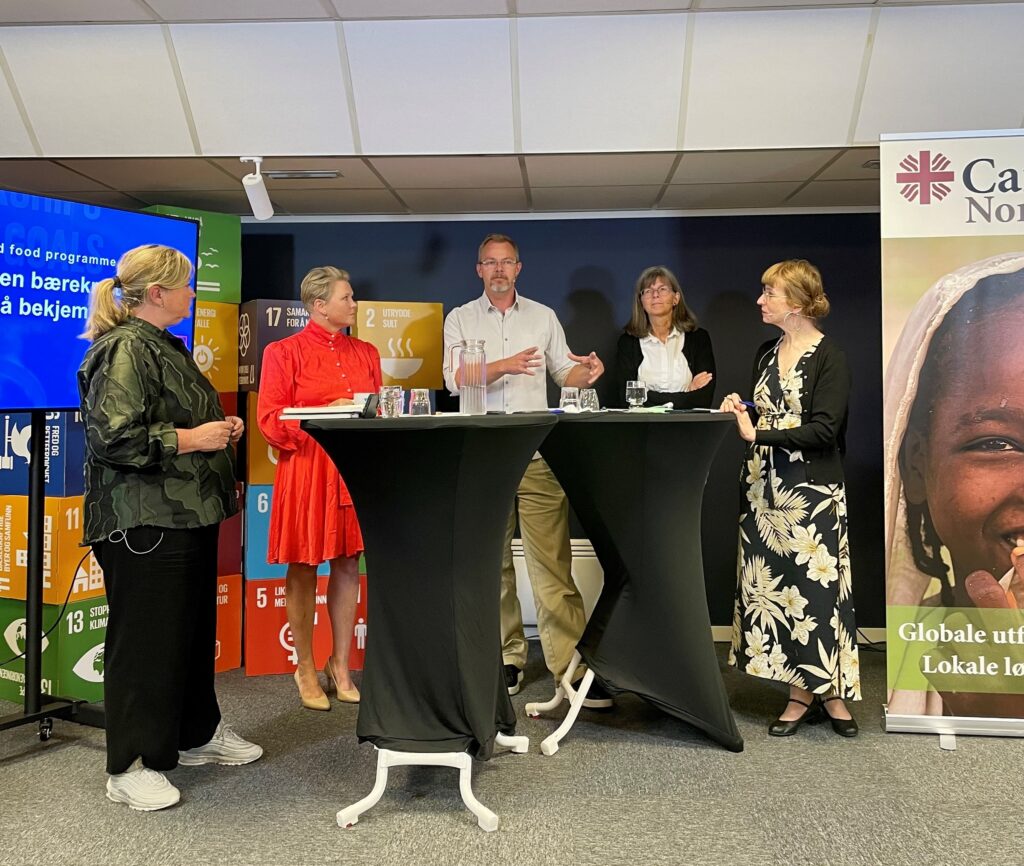
After Skretteberg's introduction, a panel discussion was held with Anne Poulsen, Director of WFP Nordic, Professor Ruth Haug, Norwegian University of Life Sciences, Minister of Development Cooperation Anne Beathe Tvinnereim and Knut Andreas Lid, Head of Long-term Development Work at Caritas.
Social dimension
The panel unanimously agreed that school meals are good. For the most sustainable solution, we need to focus on small farmers and local food production, which will strengthen local sales markets and the economy.
While financial sustainability can be challenging, school meals have a social dimension that is equally important. Haug pointed out that all research shows that school meals increase students' chances of completing school, and questioned whether school meals can become a global public good. "Food is not just a commodity, it is a right.
She was supported by Poulsen. "If parents have to consider every day whether to send their child to school or to work, then school feeding is a crucial factor and sustainable in itself. School meals improve learning, reduce hunger, ensure higher levels of inclusion of girls in education and create positive ripple effects in local communities through the use of locally produced food.
New strategy for food security
Tvinnereim revealed that the new food security strategy that will soon be presented is also about school food. On twitter, the Ministry of Foreign Affairs writes:
"that school meals are an important part of our food initiative. When food is produced and prepared locally, it creates a market for small farmers, more predictable income and children are served fresh and healthy food. This contributes to social equality and has a positive impact on girls' education in particular."
Why is school food good?
- School meals are a sustainable method of eradicating hunger. Together with the World Food Programme, we advocate that school meals must be prioritized as a solution in the Norwegian initiative on food security.
- School meals are a highly effective investment in a country's future. Every ten kroner invested gives a return of ninety kroner.
- School feeding improves learning, reduces hunger, ensures higher levels of inclusion of girls in education and can ensure positive economic ripple effects in local communities through the use of short value chains.
- Before the pandemic, half of the world's students received food at school. During the pandemic, 370 million children lost this access to food as a result of school closures.
- Countries in the South invest over NOK 2,000 billion in children's education, but only about NOK 40 billion in children's nutrition and health. The result is poorer attendance, higher dropout rates and poorer educational outcomes.